

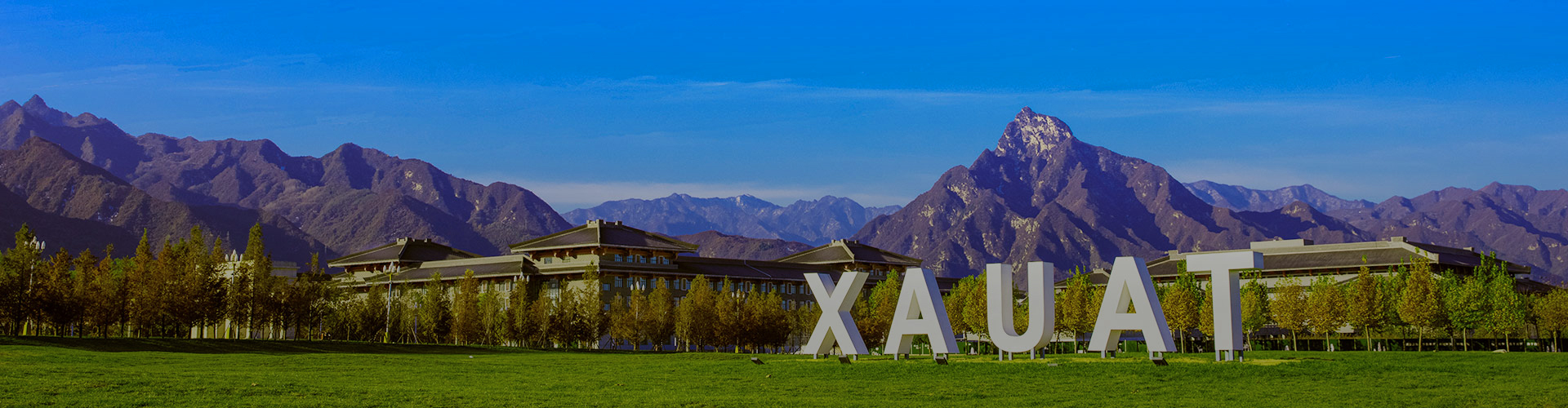
Located in the historic city of Xi'an, Xi’an University of Architecture and Technology currently has two campuses—Yanta Campus and Caotang Campus—as well as a University Science Park. Yanta Campus overlooks the world-famous Giant Wild Goose Pagoda of the Tang Dynasty to the south and borders the celebrated Ming Dynasty City Wall to the north. Caotang Campus is located at No. 1 Xuefu Road, High-tech Zone, Xi’an. The University Science Park is situated at No. 109 Xingfu South Road, Xincheng District, Xi’an, adjacent to the picturesque Chanba Ecological Zone. Together, the two campuses and the science park cover a total area of more than 2.47 km².

3700
The total area of the schoolThe University enjoys a long and distinguished history and is widely recognized for its profound academic heritage, distinctive strengths, and remarkable achievements. Its origins can be traced back to Imperial Tientsin University, founded in 1895 and later known as Peiyang University. During the nationwide restructuring of higher education institutions in 1956, the University was established through the merger of the Department of Architecture of Northeastern Institute of Technology, the Department of Civil Engineering of Northwest Institute of Technology, the Department of Civil Engineering of Qingdao Institute of Technology, and the Division of Civil Engineering and Division of Architecture of South Jiangsu Technical School. The merger brought together some of the earliest and most distinguished strengths in civil engineering, architecture, and environmental disciplines in the history of modern higher education in China. The institution was initially named Xi’an Institute of Construction Engineering and became the first university specializing in architecture in Northwest China offering full undergraduate programs after the founding of the People’s Republic of China. It is also recognized as one of China’s renowned “Old Eight Universities” of civil engineering and architecture and was formerly a key university directly administered by the Ministry of Metallurgical Industry. In 1959 and 1963, the University was successively renamed Xi’an Institute of Metallurgy and Xi’an Institute of Metallurgy and Construction Engineering. On March 8, 1994, with the approval of the former State Education Commission, it was officially renamed Xi’an University of Architecture and Technology. In 1998, the University came under the administration of the People’s Government of Shaanxi Province. It is currently a participating institution in the National Project for Building High-Level Universities and the Project for Strengthening the Fundamental Capacity of Universities in Central and Western China, and is jointly supported by the People’s Government of Shaanxi Province, the Ministry of Education, and the Ministry of Housing and Urban-Rural Development.
Over nearly 70 years of development since the institutional merger, the University has continuously strengthened its overall capacity and has grown into a multidisciplinary university characterized by strengths in civil engineering and architecture, environmental and municipal engineering, materials and metallurgy, and related disciplines, with engineering as its principal focus and coordinated development across engineering, management, art, science, literature, law, philosophy, economics, and education. The University features a comprehensive disciplinary system with distinctive academic strengths. Its leading disciplines—including green building and urban-rural planning, modern civil engineering and intelligent construction, ecological environment and emerging energy, materials metallurgy and engineering management—rank among the top tier nationwide. Disciplines such as mechatronics, information and control engineering, intelligent transportation, mathematics and optoelectronics, chemistry and chemical engineering, arts, and humanities are also highly competitive. Emerging fields including artificial intelligence, robotics, big data, cultural heritage conservation, and energy storage science and engineering show strong growth momentum.
The University has been awarded the “Special Contribution Award for Architectural Education” by the International Union of Architects (UIA), recognized by the State Council as a “National Advanced Unit for Employment,” and honored by the Central Committee of the Communist Party of China with the title of “National Advanced Grassroots Party Organization.”

The University is among the first institutions in China authorized by the State Council to confer doctoral, master’s, and bachelor’s degrees. It has three former national key disciplines: Structural Engineering, Environmental Engineering, and Architectural Design and Theory. The University has been selected for two consecutive rounds as a Shaanxi Provincial candidate institution for China’s national “Double First-Class” initiative, with Architecture designated as a provincial “Double First-Class” cultivation discipline.
Currently, XAUAT offers 13 doctoral programs (10 first-level disciplines and 3 professional degree categories), 8 postdoctoral research stations, and 46 master's programs (27 first-level disciplines and 19 professional degree categories). These programs cover 9 major disciplinary categories. Doctoral programs span three disciplinary categories: engineering, management, and interdisciplinary studies, while master’s programs cover nine categories including engineering, management, arts, science, law, philosophy, literature, education, and interdisciplinary studies, essentially encompassing all undergraduate programs offered by the University.
Focusing on its “Double First-Class” development goals, the University has continuously strengthened disciplinary development and achieved milestone progress. Architecture, Civil Engineering, and Environmental Science and Engineering made significant breakthroughs in China’s fifth-round national discipline evaluation. Urban and Rural Planning, Landscape Architecture, Management Science and Engineering, and Materials Science and Engineering also achieved expected outcomes, further consolidating the strengths of the University’s “Architecture and Technology” disciplinary cluster. Four disciplines have been included in the Ministry of Education’s recommended list of priority development disciplines, with Architecture specifically identified as a discipline striving to enter the ranks of world-class disciplines. 6 disciplines—Engineering, Environmental Science and Ecology, Materials Science, Chemistry, Biology and Biochemistry, and Social Sciences, General—rank among the top 1% globally in ESI, with Engineering ranking within the top 0.66‰ worldwide. The discipline of Architecture and Built Environment ranks 138th in the QS World University Rankings by Subject. Nine disciplines have been listed in the ShanghaiRanking’s Global Ranking of Academic Subjects, while thirteen disciplines were included in the “ShanghaiRanking’s Best Chinese Subjects Ranking,”with Architecture consistently ranked among the top 5 % nationwide.
The University currently comprises 22 schools and offers 67 undergraduate programs. Among them, 27 programs—including Architecture, Urban and Rural Planning, Landscape Architecture, Civil Engineering, Urban Underground Space Engineering, Water Supply and Drainage Science and Engineering, Environmental Engineering, Engineering Management, Materials Science and Engineering, Material Forming and Control Engineering, Environmental Design, Built Environment and Energy Application Engineering, Building Electrical and Intelligent Engineering, Cultural Industry Management, Metallurgical Engineering, Transportation Engineering, Historic Building Conservation Engineering, Business Administration, Mechanical Design Manufacturing and Automation, Computer Science and Technology, Information Management and Information Systems, Automation, Sculpture, Environmental Science, Visual Communication Design, Engineering Mechanics, and Social Sports Guidance and Management—have been included in the National First-Class Undergraduate Program Development Initiative, and 35 additional programs are under the Shaanxi Provincial First-Class Undergraduate Program Development Initiative. 16 programs, including Architecture, Civil Engineering, Engineering Management, Urban and Rural Planning, Built Environment and Energy Application Engineering, Water Supply and Drainage Science and Engineering, Environmental Engineering, Materials Science and Engineering, Metallurgical Engineering, Computer Science and Technology, Functional Materials, Mechanical Design Manufacturing and Automation, Mining Engineering, Automation, Transportation Engineering, and Mineral Processing Engineering, have successively passed national professional evaluation and accreditation.
The University is home to the State Key Laboratory of Green Building, one National International Science and Technology Cooperation Base, one National-level Think Tank, one National-level Research and Promotion Center for Scientific Achievements, two National and Local Joint Engineering Research Centers, one Provincially and Ministerially Co-established Collaborative Innovation Center, one National Technology Transfer Demonstration Institution, two Scientist Spirit Education Bases, five National Experimental Teaching Demonstration Centers/Virtual Simulation Experimental Teaching Centers, and three Design and Research Institutes with Class-A qualifications. Supported by the University, Shaanxi Province has established the Shaanxi Circular Economy Engineering Technology Institute, the Shaanxi Institute of New Urbanization and Human Settlements Research, and the Shaanxi Membrane Separation Technology Research Institute.
The University currently enrolls more than 32,900 students, including over 20,700 undergraduates, 10,300 master’s students, more than 1,500 doctoral students, and over 400 international students. The University has more than 2,200 full-time faculty members. Among them are 3 academicians currently on staff and 12 alumni academicians; 1 National Advanced Worker, 1 National Outstanding Educator, 2 recipients of the National May 1st Labor Medal, 1 National Model of Teacher Ethics, 1 National Advanced Individual in Teacher Ethics, 3 National Model Teachers, and 4 National Outstanding Teachers. In addition, 15 faculty members have been selected for major national talent programs, 7 have received the National Science Fund for Distinguished Young Scholars (Category A), 5 have received the Excellent Young Scientists Fund (Category B), 13 have been selected for the National High-level Talent Special Support Program (“Ten Thousand Talents Program”), 12 have been selected as national-level candidates of the “Hundred, Thousand, and Ten Thousand Talents Project,” and 15 in-service experts receive special government allowances from the State Council. Furthermore, 14 faculty members serve as members of National Teaching Guidance Committees, and 7 serve as members of National Evaluation and Accreditation Committees. The University has established 1 Innovation Research Group funded by the National Natural Science Foundation of China, 3 innovation teams under the Ministry of Education’s “Changjiang Scholars and Innovative Research Team Development Program,” 2 National Huang Danian-style Teaching Teams in Universities, and 1 National Advanced Collective in the Education System. This has fostered a robust faculty team characterized by a rational structure, exceptional qualifications, and formidable strength.
Since 2010, the University has won two Second Prizes of the National Technological Invention Award and eight Second Prizes of the National Science and Technology Progress Award. It has also received 12 National Teaching Achievement Awards, 3 National Excellent Textbook Awards, one Ho Leung Ho Lee Foundation Prize for Scientific and Technological Progress, recognition in the Top Ten Scientific and Technological Advances in Chinese Universities, the Xplorer Prize, and the inaugural National Innovation Excellence Award. The university has been selected as an implementing institution for the Ministry of Education's Excellent Engineer Education and Training Program and a pilot institution for the Comprehensive Reform of Professional Degree Graduate Education, as well as a CSC-designated platform university for the National High-Level University Graduate Study Abroad Program and an implementing institution for the International Exchange Program for Outstanding Undergraduates. It has also been named a National Demonstration University for Deepening Innovation and Entrepreneurship Education Reform, an Innovative Institution for Engineering Master’s Education, as well as a First-batch National-level Innovation and Entrepreneurship School Development Institution. It was also selected as one of the first National Model Universities for Employment by the Ministry of Education, a National Defense Education Characteristic Institution, and a Base for the Inheritance of Excellent Traditional Chinese Culture. The University vigorously promotes innovation and entrepreneurship education through initiatives such as the integration of coursework and competitions and comprehensive undergraduate research training programs. Students have achieved outstanding results in various international and national competitions, including six gold medals in the China International College Students’ Innovation Competition (formerly the “Internet+” Competition), six grand prizes in the “Challenge Cup” National Extracurricular Academic Science and Technology Competition, and five gold medals in the “Challenge Cup” Chinese College Students’ Entrepreneurship Plan Competition. Students have also won the highest global award in the UIA International Student Architectural Design Competition three times and first place in the International Federation of Landscape Architects (IFLA) International Student Landscape Design Competition three times. In addition, students have repeatedly won top prizes in competitions such as the National Mathematical Contest in Modeling, National English Competition for College Students, National College Students Engineering Practice and Innovation Competition, National Structural Design Competition, Advanced Mapping Technology Competition, National Software and Information Technology Competition, China Intelligent Manufacturing Challenge, BIM Graduation Design Innovation Competition, National Metallographic Skills Competition for College Students, National 3D Digital Innovation Design Competition, and National Digital Art Design Competition. The University ranked first among universities in Shaanxi Province in the 2023 National College Student Competition Ranking.
The University has established friendly cooperative relationships with more than one hundred universities and institutions in over thirty countries and regions, including the United Kingdom, Germany, France, the United States, Italy, Norway, Australia, Japan, Hong Kong, Macao, and Taiwan. It initiated the “Silk Road International Alliance of Architectural and Technological Universities” to build a new international hub for architectural science and technology along the Silk Road and continuously advance practical cooperation with countries participating in the Belt and Road Initiative. The University has been approved to establish 11 national- and provincial-level discipline innovation and talent introduction bases for higher education institutions, as well as 6 national- and provincial-level international science and technology cooperation bases. The University actively promotes the internationalization of innovative talent cultivation and has continuously received approval for talent development programs funded by the China Scholarship Council. Leveraging its disciplinary strengths, the University has built the “Study at XAUAT” brand and serves as an implementing institution for scholarships such as the “Sanqin Scholarship” and the Xi’an “Belt and Road” Scholarship. To date, it has welcomed more than 1,000 outstanding international students from over 40 countries, including Germany, the United States, Russia, and Kazakhstan, for study and exchange programs.
Over nearly 70 years since the merger, the University has remained rooted in western China and forged its educational mission of “Inheriting Civilization, Pioneering the Future, Cultivating Talent for National Rejuvenation, and Advancing Prosperity through Science and Technology.” It has cultivated the university motto of “Striving for Self-Reliance, Practicing Diligence, Seeking the Source, Pioneering Innovation” and established the fine tradition of “Integrity in Character, Solidity in Foundation, Pragmatism in Conduct, and Diligence in Work.’ The University has trained and delivered more than 350,000 outstanding professionals for national development and has become an important talent cultivation base for China’s civil engineering, architecture, environmental and municipal engineering, and materials metallurgy sectors.
Looking to the future, the University will continue to uphold Xi Jinping Thought on Socialism with Chinese Characteristics for a New Era as its guiding principle, fully implement the fundamental mission of fostering virtue through education, and adhere to its educational philosophy of “building the University through academic excellence and serving the nation through self-reliance.” Rooted in western China, committed to serving industrial development, dedicated to seeking truth and pursuing practical results, and striving with determination and enterprise, the University will advance the development of its “11445” strategic framework and endeavor to build itself into a world-class hub of architectural science and technology along the Silk Road, boasting the most comprehensive range of disciplines, the largest talent cultivation scale, and the highest academic standing in the region.

32900 +
Students2200 +
Full-time teachers
-
Yanta Campus
No. 13, Middle Section, Yanta Road, Beilin District, Xi'an City, Shaanxi Province, China
710055
-
Caotang Campus
No. 1, Xuefu Road, High-tech Zone, Xi'an City, Shaanxi Province, China
710311
-
University Science Park
No. 109, South Xingfu Road, Xincheng District, Xi'an City, Shaanxi Province, China
710043
-
International Affairs
+86-29-82202169
oia@xauat.edu.cn
-
Human Resources
+86-29-82202759
perrsc@xauat.edu.cn
-
International Admissions
+86-29-82201031
sie@xauat.edu.cn
-
Media Relations
+86-29-82202902
jdxcb@xauat.edu.cn
Copyright©Xi'an University of Architecture and Technology | 陕ICP备05001615 V8.0-2014