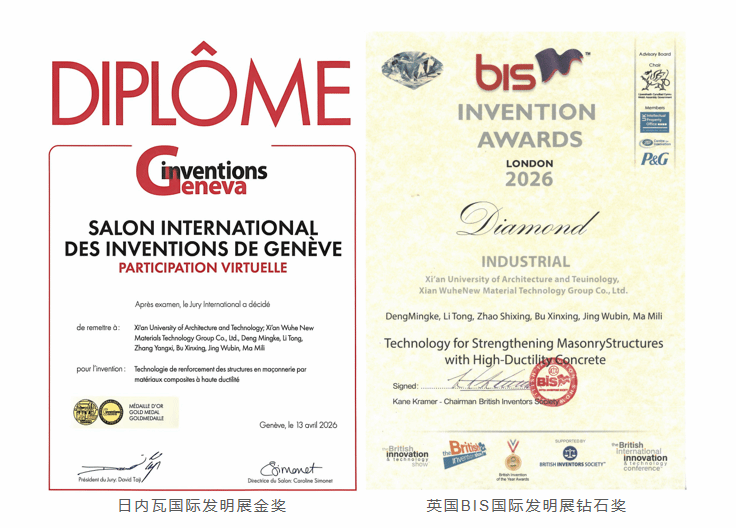
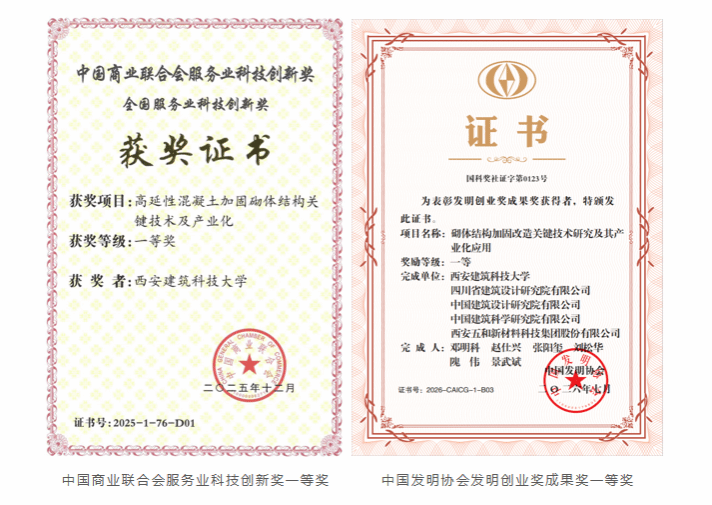
XAUAT News Network — Recently, the technology developed by XAUAT’s High-Ductility Composite Materials Research Team for strengthening masonry structures with high-ductility composite materials won two major international awards: the Gold Medal at the 51st International Exhibition of Inventions Geneva and the Diamond Award at the BIS Invention Awards London 2026. The technology also received two prestigious domestic awards: First Prize in the 17th National Service Industry Science and Technology Innovation Award of the China General Chamber of Commerce and First Prize in the 2026 Invention and Entrepreneurship Award of the China Association of Inventions. These achievements demonstrate the strength of XAUAT’s scientific and technological innovations backed by independent intellectual property rights.
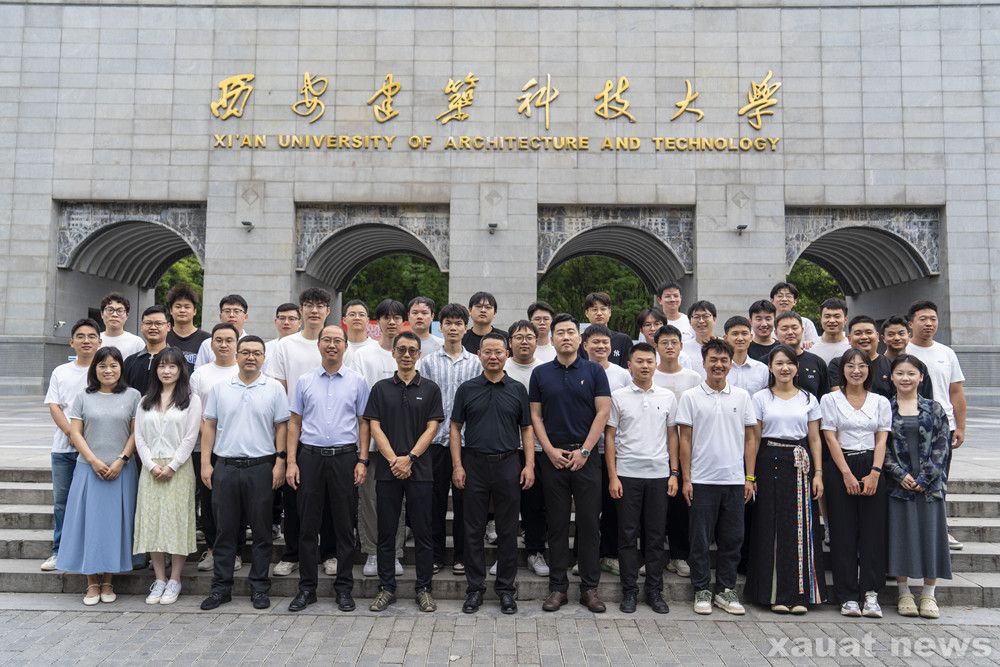
Led by Professor Deng Mingke of the School of Civil Engineering and supported by XAUAT’s Institute of High-Ductility Composite Materials, the research team has long been based in northwest China, conducting systematic research on structural earthquake resistance and engineering strengthening. Focusing on the optimization of material properties and the enhancement of structural safety, the team has developed a comprehensive technological framework spanning material design, mechanical mechanism analysis, structural testing and validation, and engineering application. The high-ductility composite materials developed by the team feature high strength, high ductility and excellent crack-control performance. Their ultimate tensile strain exceeds 3.0%, approximately 300 times that of ordinary concrete. Under bending, the materials exhibit deformation behavior similar to that of steel, earning them the name “bendable concrete.” The research findings have undergone four rounds of scientific and technological novelty searches organized by the Ministry of Education, in 2014, 2017, 2021 and 2023. The team’s strengthening technology involves applying a layer of high-ductility composite material to the surface of masonry structures. The strong bond between the composite layer and the masonry components enables them to act together as an integrated structural system. During an earthquake, the material’s high strength, excellent crack resistance and strong damage tolerance help improve structural integrity and significantly enhance seismic performance. To date, the technology has been applied in all 31 provincial-level regions of China, including provinces, autonomous regions and municipalities directly under the central government. It has been used in more than 10,000 engineering projects and in the strengthening of over 150,000 rural houses. The team’s technological achievements have been featured on China Central Television (CCTV) five times and widely covered by hundreds of mainstream media outlets, including Guangming Daily and Science and Technology Daily.
The International Exhibition of Inventions Geneva, the British Invention Show and the invention exhibitions in the United States and Germany are widely recognized as four major international invention exhibitions. The China General Chamber of Commerce’s Science and Technology Innovation Award for the Service Industry was established with approval from the Ministry of Science and Technology and the National Office for Science and Technology Awards. The Invention and Entrepreneurship Award of the China Association of Inventions is registered with the National Office for Science and Technology Awards, and the association is qualified to nominate candidates for national science and technology awards. The four awards recognize both the originality and practical value of XAUAT’s technology for strengthening masonry structures with high-ductility composite materials. They also acknowledge the team’s contributions to scientific and technological innovation in the service sector, deeper integration of industry, academia and research, and technological advancement across the industry. Looking ahead, the team will continue to address key technological challenges and promote the application of its research findings, contributing to improved seismic safety in buildings across China and supporting high-quality development in urban and rural construction.